Yemen's Separatists Unveil Plan for Southern Independence
Escalation in Yemen's Southern Separatist Movement
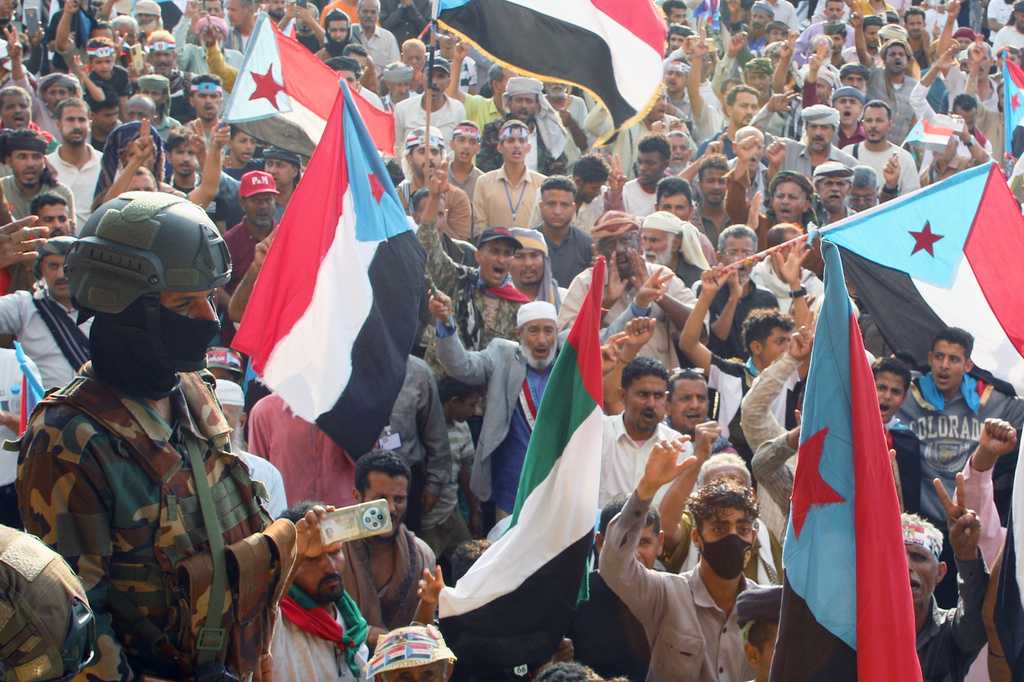
Yemen’s separatist movement took a significant step forward on Friday by announcing a constitution for an independent nation in the south. This move has sparked tensions between various factions in the war-torn country, with Gulf powers Saudi Arabia and the United Arab Emirates (UAE) finding themselves at odds.
The UAE-backed Southern Transitional Council (STC) presented the announcement as a declaration of independence for the southern region. However, it remains uncertain whether this move is practical or primarily symbolic. Earlier this month, STC-linked fighters seized control of two southern provinces from Saudi-backed forces and took over the Presidential Palace in Aden, forcing members of the internationally recognized government to flee to Riyadh.
Saudi Arabia's Response
On Friday, Saudi warplanes bombed camps and military positions held by the STC in Hadramout province as Saudi-backed fighters attempted to seize these facilities, according to a separatist official. This marks the latest instance of direct intervention by Saudi Arabia, which has recently targeted STC forces and struck what is alleged to be a shipment of Emirati weapons intended for the separatists.
Meanwhile, the UAE announced early Saturday that it had completely withdrawn all its troops from Yemen. This follows its pledge to do so after the recent confrontation.
The Broader Conflict
Although Saudi Arabia and the UAE, along with their allies on the ground in Yemen, have been part of a Saudi-led coalition fighting Iranian-backed Houthi rebels, the situation has become increasingly complex. The coalition's stated goal has been to restore the internationally recognized government, which was driven out of the north by the Houthis. However, tensions among the factions and the two Gulf nations are causing the coalition to unravel, potentially leading to outright conflict and further destabilizing the Arab world's poorest country.
Southern Separatists' Declaration
The head of the STC, Aidarous al-Zubaid, issued a video statement on Friday, stating that the constitution his group released would be in effect for two years. After that period, a referendum would be held on “exercising the right to self-determination for the people of the South.” During those two years, he emphasized that the “relevant parties” in the north and south should engage in dialogue on “a path and mechanisms that guarantee the right of the people of the South.”
If other factions do not agree to his call or take military action, he warned that “all options remain open.” The 30-article “constitution” proclaimed the creation of “the State of South Arabia,” covering the same territory as the former People’s Democratic Republic of Yemen, which existed from 1967 to 1990.
This appears to be the most overt move yet by the STC toward its long-standing goal of independence. However, the practical impact of the declaration remains unclear due to the ongoing confusion in the south. Nonetheless, the move could hinder efforts to prevent an outright conflict between the separatists and the rest of the Saudi-led coalition.
UAE's Stance
The UAE Foreign Ministry stated on Friday that the country was dealing with the situation “with restraint, coordination, and a deliberate commitment to de-escalation, guided by a foreign policy that consistently prioritizes regional stability over impulsive action.”
The UAE Defense Ministry also announced early Saturday that its withdrawal of troops from Yemen was complete. While no details were provided about the number of soldiers and equipment moved, there had been multiple Emirati military cargo flights heading in and out of Yemen in the last few days.
“The UAE forces follow the implementation of a previously announced decision to conclude the remaining missions of counterterrorism units,” a Defense Ministry statement said. “The process has been conducted in a manner that ensured the safety of all personnel and carried out in coordination with all relevant partners.”
Ongoing Fighting in the South
The Saudi-led coalition in Yemen demands the withdrawal of the STC-linked Southern Shield forces from the two governorates they seized—Hadramout and Mahra—as part of de-escalation efforts. The STC has so far refused to hand over its weapons and camps.
Saudi-backed fighters, known as the National Shield Forces, advanced on two STC-camps in Hadramout, according to a senior STC official, Ahmed bin Breik, a former governor of the province. The separatist forces refused to withdraw, leading to Saudi planes striking the camps, he said.
Mohamed al-Nakib, spokesperson for the STC-backed forces, reported that the strikes caused fatalities, though no details were provided. The Associated Press could not independently verify this claim. He later told the AP that “intense clashes” erupted between his forces and the National Shield forces across several areas of Hadramout.
It remains unclear whether the Saudi-backed forces succeeded in retaking the camps.
Escalating Tensions
In a post on X, the Saudi ambassador to Yemen, Mohammed al-Jaber, stated that the kingdom had tried “all efforts with STC” for weeks to stop the escalation and urge the separatists to leave Hadramout and Mahra. However, he noted that the STC had shown “continued intransigence and rejection from Aidarous al-Zubaidi.”
Al-Jaber mentioned that the STC had not allowed a Saudi delegation's jet to land in Aden, despite having agreed on its arrival with some STC leaders to find a solution that serves “everyone and the public interest.”
Yemen’s Transportation Ministry, aligned with the STC, claimed that Saudi Arabia imposed requirements mandating that flights to and from Aden International Airport undergo inspection in Jeddah. The ministry condemned the decision, but there was no confirmation from Saudi authorities. A spokesperson with the transport ministry told the AP late Thursday that all flights from and to the UAE were suspended until Saudi Arabia reverses these reported measures.
Posting Komentar