Dow Rises on 2026's First Day, No Santa Claus Rally in Sight
Market Gains and Mixed Performance in Early 2026
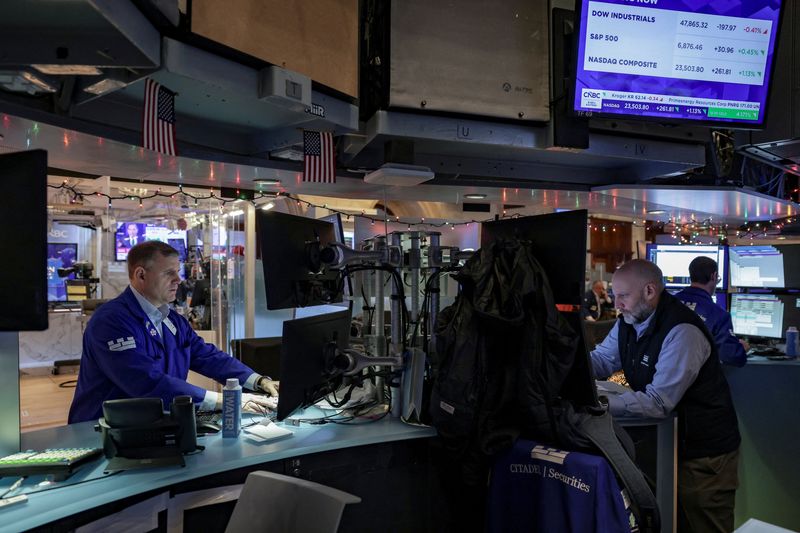
The U.S. stock market started the year on a positive note, with the Dow Jones Industrial Average and the S&P 500 indexes closing higher on Friday. This marked the end of a four-day losing streak, driven by gains in key sectors such as technology and industrials. Chipmakers like Nvidia, Intel, and Boeing played a significant role in boosting investor sentiment.
In 2025, all major indices—Dow, S&P 500, and Nasdaq—recorded double-digit gains, marking their third consecutive year of positive performance. This trend had not been seen since the period between 2019 and 2021.
On Friday, chip stocks were particularly strong, with the Philadelphia SE Semiconductor index rising by 4%. The industrial and utility sectors also saw gains, with Caterpillar and Boeing increasing by 4.5% and 4.9%, respectively. These movements helped lift the Dow Jones Industrial Average, which gained 319.10 points, or 0.66%, to close at 48,382.39.
However, the broader market was not entirely positive. While some big names like Apple and Microsoft declined, they helped keep the gains in check for the S&P 500 and Nasdaq. Additionally, consumer discretionary stocks, including Amazon, faced losses, and Tesla fell by 2.6% after reporting its second consecutive year of declining annual sales.
The S&P 500 rose by 12.97 points, or 0.19%, to close at 6,858.47, while the Nasdaq Composite dipped slightly by 6.36 points, or 0.03%, to 23,235.63.
Joe Mazzola, head of trading & derivatives strategist at Charles Schwab, noted that the market is currently exhibiting a "buy the dip, sell the rip" mentality. This strategy involves profiting from short-term volatility by timing entry and exit points.
Mazzola added that investors are becoming more cautious about the valuations of AI-related investments but remain willing to buy during pullbacks. He emphasized that this behavior is unlikely to change soon.
Smaller stocks, which had struggled in recent days, also experienced a rally. The Russell 2000 index climbed by 1.1%, ending a four-day losing streak.
Federal Reserve's Role in Shaping 2026 Markets
The Federal Reserve’s monetary policy trajectory is expected to be a key factor influencing global markets in 2026. Recent economic data and the anticipated appointment of a new dovish Fed chair have led investors to price in further interest rate reductions.
Dennis Dick, chief market strategist at Stock Trader Network, predicted that the next Fed chair would likely be more dovish than Jerome Powell. He suggested that interest rates could decrease substantially in the second half of the year, benefiting all stocks, not just tech companies.
A key event in January will be the release of labor market data, following warnings from Powell at the central bank’s December meeting about the need for clarity on jobs before considering further rate cuts.
Wall Street's Recovery and Tariff Implications
Wall Street made a strong comeback in 2025, recovering from April’s lows when Trump’s “Liberation Day” tariffs triggered a global market meltdown. This event led to a temporary exodus of investors from U.S. stocks and created uncertainty around interest rates.
Potential tariff surprises from Trump remain a concern, especially after the White House announced a delay in tariff increases for items such as upholstered furniture, kitchen cabinets, and vanities. This move positively impacted furniture retailers, with shares of Wayfair, Williams-Sonoma, and RH rising by 6%, 5%, and nearly 8%, respectively.
Market Activity and Volume
On the New York Stock Exchange, advancing issues outnumbered decliners by a ratio of 2.01-to-1. There were 236 new highs and 95 new lows recorded on the NYSE.
On the Nasdaq, 2,978 stocks advanced while 1,818 declined, resulting in an advancing-to-declining ratio of 1.64-to-1. The S&P 500 posted 9 new 52-week highs and 9 new lows, while the Nasdaq Composite recorded 54 new highs and 79 new lows.
U.S. exchanges saw a total volume of 15.92 billion shares, slightly above the 15.87 billion average for the full session over the last 20 trading days.
Posting Komentar